Most Solana actions have a "what if" attached to them. What if the swap pays out way less than expected? What if my keeper bot runs too late? What if this close drains the account below rent? Today you either trust the destination program to check these things, or you skip the check.
Shield is a third option. Each "what if" becomes its own tiny program. You prepend it to your real instruction inside the same transaction. Solana already has a rule: if any instruction in a transaction returns non-zero, the whole transaction aborts. So if the guard says "no", the swap (or transfer, or mint) never happens. No partial progress, no cleanup, no risk.
The guards are written in raw sBPF assembly, not Anchor, not Pinocchio, not Rust. They are a few hundred bytes each and most of them cost less than 10 compute units, which is roughly free on a 1.4M CU budget.
The seven guards
| Guard | CU (happy path) | What it asserts |
|---|---|---|
slot_deadline | 152 | current slot is at or below max_slot |
slippage | 7 | spl-token amount on account 0 is at or above min_amount |
balance_floor | 7 | account 0 holds at least min_lamports |
signer_allowlist | 25 (N=1) | signer is one of N pubkeys, and is_signer == 1 |
fee_ceiling | 86 | every SetComputeUnitPrice in this tx is at or below the ceiling |
program_allowlist | 80 (N=1) | every other top-level ix targets a program on the allowlist |
compute_unit_floor | 93 | tx declares SetComputeUnitLimit of at least min_units |
Each guard is a single-purpose program with its own pubkey, deployed at the same address on devnet and mainnet. You do not install a library. You point an instruction at the guard's program ID, pass it the numbers it needs to check, and put it in front of your real action.
How a guarded swap actually composes
import { Connection, PublicKey, Transaction } from "@solana/web3.js"
import {
  slotDeadlineIx,
  slippageIx,
  balanceFloorIx,
  feeCeilingIx,
} from "@solana-asm/shield"

const slot = await connection.getSlot()

const tx = new Transaction()
tx.add(slotDeadlineIx({ maxSlot: BigInt(slot + 100) }))
tx.add(feeCeilingIx({ maxMicroLamports: 5_000n }))
tx.add(balanceFloorIx({ account: signer.publicKey, minLamports: 1_000_000n }))
tx.add(slippageIx({ tokenAccount: outAta, minAmount: 1_000_000n }))
tx.add(yourSwapInstruction)
On the happy path, the runtime executes guards left-to-right, each returns zero, and the swap runs. On the unhappy path, any guard returning non-zero aborts the entire transaction atomically: the slippage check, the swap, every state mutation, all undone. The chain returns to exactly the state it was in before the signature landed.
The atomic guarantee is the only thing in this design we did not invent. Everything else is a thin layer over a property Solana already gives you.
Why pure assembly
Three reasons, in order of weight.
Size. A guard like slippage is a handful of memory reads and one comparison. In assembly that lands at ~400 bytes on chain. The same logic through Anchor lands at tens of kilobytes once the runtime, the IDL discriminator dispatch, and the standard validators are linked in. For a program that does one thing, the framework tax is the whole program.
Compute. slippage is 7 CU. balance_floor is 7 CU. slot_deadline is 152 CU because it has to call sol_get_clock_sysvar. A swap with deadline, slippage, and balance-floor protection adds ~166 CU on top of the swap itself. At Solana's per-tx cap of 1.4M CU this is below the noise floor.
Audit clarity. A few hundred bytes of assembly is something one person can read in an afternoon and convince themselves of. There is no derive macro to expand, no monomorphized helper to chase, no runtime to step through. The dispatch table is the program.
We have a dedicated chapter on each idiom the guards use in the sBPF book: the input layout the loader hands you at r1, the offset where instruction data lives, how to call a syscall by helper ID, and how to compose a .s file that builds with the sbpf toolchain.
Where it runs
- Live demo at shield.sbpf.dev. Builds a transaction with up to four guards, simulates against devnet or mainnet, shows per-guard CU cost and the abort log.
- SDK on npm as
@solana-asm/shield. Tree-shakeable, one builder per guard, runs in node and the browser. - All seven program IDs live at the same addresses on devnet and mainnet. See the README for the table.
Early traction
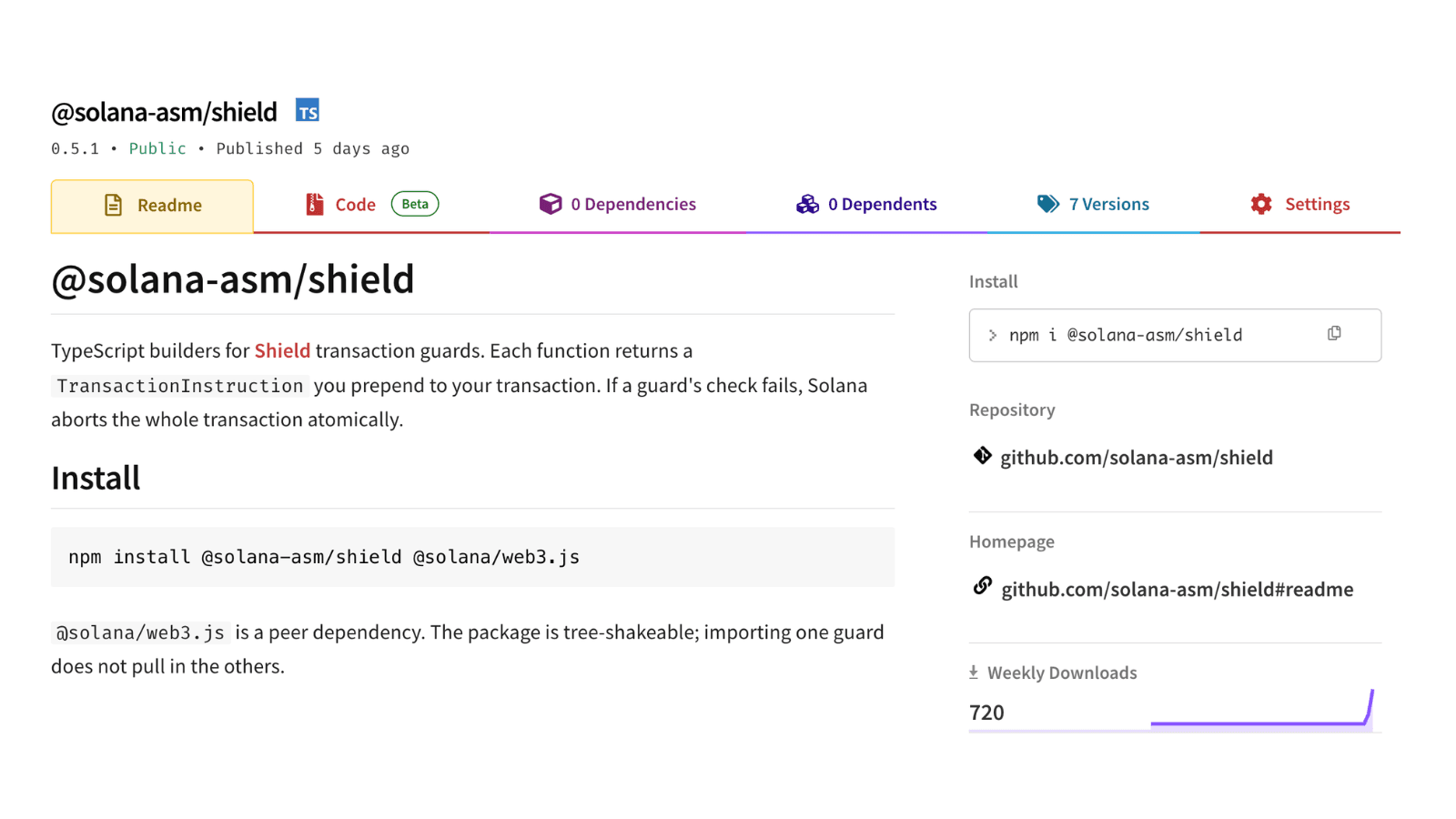
@solana-asm/shield crossed 700 weekly downloads in its first week on npm, before this post existed. Small absolute number, but encouraging for a package whose ergonomic surface is "one builder per guard, you opt into each one per instruction." Thanks to the keeper bot and agent runtime teams that picked it up early without us asking.
What is next
The first set of guards covers the failure modes we kept seeing while writing keeper bots and agent flows. The interesting question is which other "what if"s belong in this shape. Candidates we are looking at: pyth price freshness, on-chain memo audit trails, nonce-based replay protection for off-chain-signed intents, and a generic SPL-Token delegate ceiling.
If a guard belongs in Shield, it should answer one yes/no question, be stateless, cost under ~200 CU, and produce a short sol_log_ line before any non-zero exit so devnet diagnostics stay usable without a custom client. PRs against the repo are welcome.
Follow @solana_asm for the next guard.